The Hidden Engineering Behind Safe Solar Installations
- Taurick Stofberg

- May 6
- 4 min read
Updated: May 10
Why Proper Design and Compliance Matter
For many years, electrical systems in homes and businesses followed a simple principle: electricity came from the utility, and the responsibility for generation, network protection, and upstream stability remained with the supply authority.
Today, that has changed.
Modern solar installations fundamentally change the role of the property owner — from simply consuming electricity to actively generating it. Once solar panels and battery systems are installed, a building effectively becomes part of a small-scale power generation system.
And with that comes a new level of responsibility.
At Stofberg Electrical, we believe solar should never be approached as “just another installation.” It must be approached with the same engineering mindset, protection philosophy, and compliance discipline that applies to any electrical generation environment.
That is where many problems in the current market begin.
Solar Is Not Just an Appliance
One of the biggest misconceptions in the industry is treating solar equipment like a household appliance.
A solar installation is not simply:
an inverter mounted on a wall,
a few batteries,
and panels on a roof.
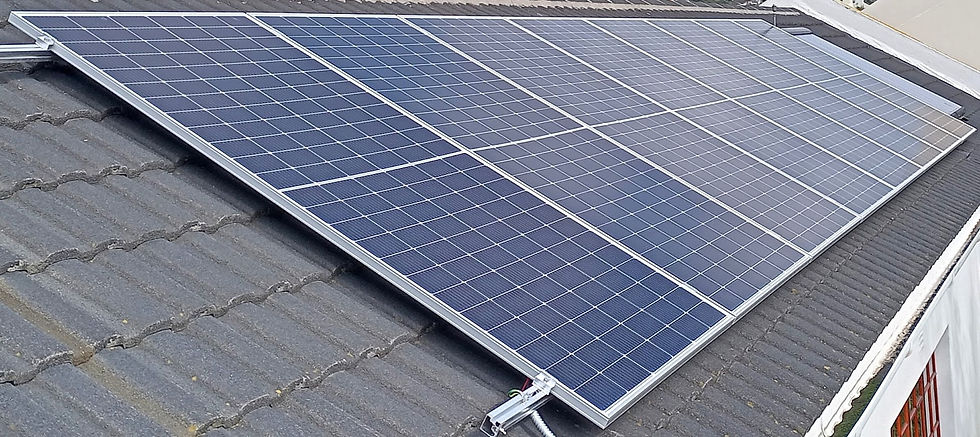
It is an active electrical generation system that operates continuously whenever sunlight is present.
Unlike conventional AC circuits, solar panels cannot simply be “switched off” during daylight hours. Even when isolators are opened, the panels themselves remain live DC generation sources. This is why proper protection design, correct equipment selection, and compliant installation practices are critical.
Historically, Eskom and municipal utilities managed these risks at utility scale through carefully engineered protection schemes, earthing systems, and network coordination.
Today, many of those same responsibilities now exist inside private homes, schools, estates, and commercial properties.
The “utility boundary” has effectively moved onto the client’s roof.
Most Solar Problems Are Design Problems
Over the past few years, we have increasingly been called out not to install new systems — but to investigate why existing systems are malfunctioning.
And in many cases, the root problem is not defective equipment.
It is poor design.
Sometimes the installation itself is neat and visually impressive, but the system was never properly designed around the client’s actual load profile, operational requirements, or protection philosophy.
Unfortunately, once equipment has already been purchased and installed incorrectly, the solution often becomes expensive.
Real-World Examples We Encounter
Incorrect Load Profiling and Inverter Sizing
At one school facility, an inverter system had been installed to support a large portion of the campus load. However, the inverter and backup architecture had not been properly designed around the actual operational demand of the site.
To protect the inverter, the upstream breaker had effectively been derated below the building’s real operating load requirements. Under normal utility conditions, the inverter could pass through the required current, but once backup conditions occurred, the system limitations became apparent.
As winter demand increased through heaters and additional classroom loads, nuisance tripping became increasingly likely.
The solution was not simply “replace a breaker.” The issue originated from the original system design and load management philosophy.
A properly designed installation would have considered:
load prioritisation,
contactor-based load shedding,
backup sequencing,
and operational behaviour during utility failure conditions.
Battery Systems That Could Never Realistically Perform
In another case, a large estate planned to install a substantial battery bank intended to support overnight operation of the entire property.
However, the available solar array capacity was far too small to realistically recharge the batteries during daytime operation.
The system effectively relied on utility charging to sustain battery operation, defeating much of the intended benefit while also introducing charging limitations imposed by utility regulations and supply constraints.
From a design perspective, the system was fundamentally mismatched:
battery storage exceeded realistic charging capability,
solar generation was insufficient,
and the operational expectations of the client could never realistically be achieved.
This highlights a critical issue in the market: a system can appear impressive on paper while still being operationally flawed.
Compliance Is Not Paperwork — It Is Protection
One of the biggest misunderstandings in the industry is viewing compliance as an administrative exercise rather than a safety and protection discipline.
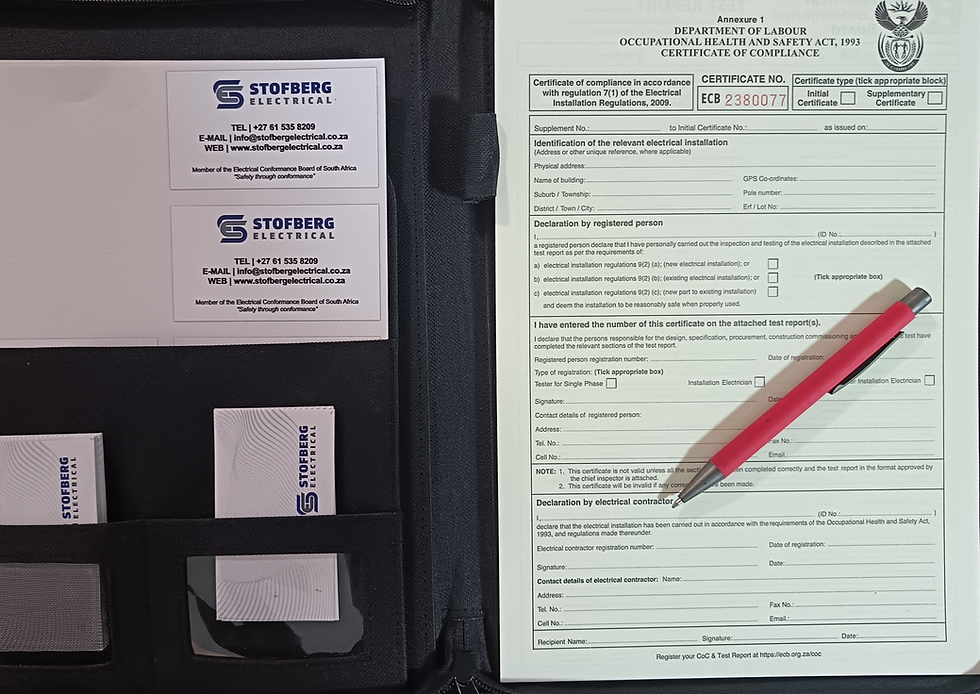
A Certificate of Compliance is not simply a form.
It represents responsibility.
At Stofberg Electrical, we believe responsibility extends across:
system design,
equipment selection,
procurement standards,
installation quality,
and long-term operational safety.
This includes ensuring:
approved and compliant equipment is used,
protection devices are correctly coordinated,
earthing systems are properly designed,
neutral integrity is maintained,
and installation methods align with current standards and regulations.
Because ultimately, poorly designed systems do not merely create inconvenience.
They create operational instability, equipment damage, and in some cases, serious fire risk.
The Importance of Protection Philosophy
One of the most overlooked aspects of modern solar installations is protection philosophy.
Traditional electrical systems were designed around utility-fed AC infrastructure. Solar introduces high-voltage DC generation into environments that were never originally designed for it.
This creates entirely different considerations.
For example:
improper neutral handling on three-phase systems can create dangerous voltage imbalances,
poor earthing continuity can compromise surge protection performance,
incorrectly sized conductors can undermine fault-clearing capability,
and mismatched MC4 connectors can create high-resistance joints capable of generating heat and arcing faults.
Many of these failures are invisible during handover.
They only become apparent months later under operational stress.
And by then, the consequences can be expensive.
Experience Matters
Technical compliance alone is not enough.
Real-world fault-finding experience matters.
Many of the issues we encounter today are not textbook problems. They are operational problems that only reveal themselves under real site conditions:
during load shedding,
during backup transitions,
under winter loading,
or months after commissioning.
That is why solar design should never be approached purely from a sales perspective.
It must be approached from an operational perspective.
At Stofberg Electrical, our approach is rooted in years of electrical infrastructure, compliance, and fault-finding experience. We believe solar systems should not only work on commissioning day — they should continue operating safely, reliably, and compliantly for years to come.
Final Thought
As solar adoption continues to grow across South Africa, the conversation should move beyond simply:
“How many panels?”
“How many batteries?”
or “How much backup time?”
The more important question is:
Was the system properly designed for the way the building actually operates?
Because when a property begins generating electricity, safety, protection, compliance, and design integrity become just as important as energy production itself.
And that is where experience makes the difference.
Comments